

Monidła in 20th-Century Poland:
Between Art, Commerce, and Social Aspiration
The aim of this article is to examine monidła as a widespread yet poorly documented visual and vernacular form, characteristic of Polish everyday culture in the twentieth century. The text focuses on the conditions of their production, modes of distribution, and patterns of use within the domestic space. Particular attention is given to practices of modifying the appearance of the portrayed individuals, the role of monidła in sustaining individual and collective memory, and the significance of their placement within the homes of their owners.
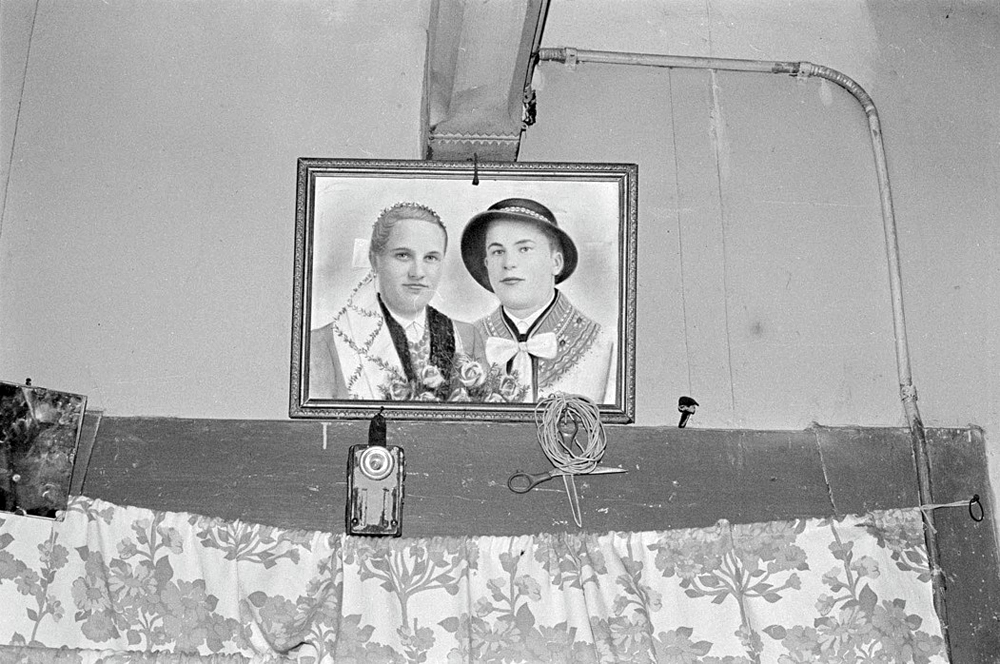
Monidło, Photograph from Zofia Rydet’s photo series Sociological Record, Chochołów, 1982 © Zofia Augustyńska-Martyniak. Image available under the CC BY-NC-ND 3.0 PL license. Source: zofiarydet.com
Introduction
“You still have that? I thought it was long gone. I would have thrown it out years ago,”[1] Władysław remarked jokingly when his wife Otolia suggested bringing up their wedding portrait from the basement. His light tone irritated her. “What are you talking about? I could never throw it away,”[2] she replied, visibly upset. Moments later, Otolia returned with a slightly damaged, dusty portrait of a young couple, which she began to clean with care, brushing off cobwebs and dust. The image showed two young people with calm expressions, both looking straight ahead. Their features appeared blurred. The couple was dressed formally: the man wore a black suit with a white shirt and a bow tie, while the woman was dressed in a white gown with a veil and held a bouquet of roses in her hand. There was something intriguing about the image that immediately drew attention. It was easy to notice that this was not simply a photograph commemorating a wedding day, as one might have expected. Nor was it an oil painting. The answer to the question of what it was inspired me to undertake this study.
I became interested in so-called “painted portraits” in 2023 during fieldwork in Poland focused on rural residents’ experiences of practices related to photography, primarily from the 1960s to the 1980s, and on the role of photographic images in shaping memory.[3] During the interviews in which participants shared personal stories and family photographs, a recurring motif quickly emerged, appearing in nearly every meeting. When I asked them to show me their photographs, interviewees reached not only for albums, loose prints, or images stored in envelopes, but also for a distinct type of image retrieved from wardrobes or basements. These were not limited to wedding portraits, but also included images of children, adults, and entire families. Despite depicting different individuals, the figures shared strikingly similar facial features, giving the impression that the portraits had been produced according to a single visual scheme.
In this article, I examine the phenomenon of monidła (plural form of monidło), images that for a long time functioned in many Polish homes. Although extremely widespread, the phenomenon remains poorly documented and does not fit easily into established categories, situated somewhere between photography and painting, rural and urban contexts, as well as between fascination and aversion. Monidła resist straightforward classification, despite the fact that they were mass-produced and largely standardized. By the late 1970s, they had largely disappeared from domestic interiors, only recently re-emerging as objects of scholarly and curatorial interest. By examining their production, circulation, and domestic use, this article shows that they functioned not merely as commercial products but as a vernacular visual practice linking private life with popular culture in twentieth-century Poland.
A review of the scarce academic literature about monidła indicates that they have not yet been the subject of extensive research.[4] At the same time, interest in them has grown outside academia in recent years, particularly through initiatives undertaken by local cultural institutions that collect and exhibit such portraits.[5] The analysis presented here combines several research perspectives: a visual analysis of the objects themselves, interviews with producers, collectors, and buyers of these images, and the examination of archival documents that enable the reconstruction of practices of production and circulation. My interest lies not only in monidła as material objects but also in the stories behind them: the circumstances of their commission, the ways they were used, and the meanings attributed to them by their owners. As elements of everyday life and objects of a distinctly private character, they require attention less for their visual qualities but rather for the social contexts in which they functioned.
The specific nature of monidła, objects rooted in rural and working-class communities and used primarily within the private sphere, means that relatively few archival sources have survived that would allow for their comprehensive analysis. For this reason, interviews constitute a central research tool, enabling the reconstruction of production practices, distribution networks, and domestic modes of use associated with these images. Both interviews and archival materials suggest that buyers expected these portraits to enhance the appearance of the depicted individuals, yet without erasing their distinctive features. The monidło was meant to present a “better”, festive version of the person while still preserving recognizable traits.
What, then, does the notion of monidło actually denote? In this article, it refers to painterly-photographic or drawing-photographic portraits.[6] These images were based on enlarged photographs that were subsequently altered through manual painterly or graphic interventions, using paints, crayons, or other materials. The aim of these modifications was to endow the image with the appearance of a painted portrait.[7] The uniqueness of monidła, compared to conventional photographs, resulted, among others, from their perception and the values that were attributed to them. They were seen as something new, fashionable, and worth having. They enabled the combination of photographs of different people into a single image and the creation of scenes that had never existed in reality.
Monidła were produced on a mass scale and were particularly common in rural and working-class communities in Poland during the twentieth century.[8] Both small photographic studios and private producers were involved in their production. However, a dominant role played large photographic cooperatives, which used networks of pedlars to reach audiences across Poland. This article focuses on works produced in a (semi-)mass manner by such cooperatives.[9] Although monidła are most often associated with wedding portraits, they also included other types of representations, such as individual portraits. A defining feature of monidławere various attributes and deliberate modifications made in relation to the original photograph. Hairstyles, added jewellery, or changes to elements of clothing allowed for the personalization of appearance according to clients’ preferences. However, this was not a universal rule. Among these images, one can also find the so-called “original” versions, intended to resemble the photograph as closely as possible.
The etymology of the term monidło has not been conclusively established. Scholars who have addressed the subject most often point to a possible connection with the Polish verb mamić, meaning “to deceive, to entice with false appearances, or to raise illusory hopes,”[10] as well as the noun mamidło, referring to something that exerts a seductive or misleading attraction.[11] In this reading, the term monidło would emphasize the illusory or deceptive qualities attributed to these images.
The origin of the term is difficult to trace, as it is impossible to identify a specific moment of its emergence. All indications suggest that it initially functioned in oral circulation, primarily within environments involved in the production and distribution of this type of portrait, rather than in direct communication with clients. Those who purchased such images typically referred to them simply as “portraits”.
Monidła were produced on a large scale not just in Poland. Similar practices are known from other European countries, including Germany, Austria, Sweden, Spain, and Romania. The ethnographer and writer Olga Drenda notes that “Poland here enters into an alliance with Brazil, where retratos pintados, photographs intensively retouched with paint and strikingly similar to Polish monidła, were produced, […] as well as with Mexico, with its tradition of fotoescultura: sculpted frames in which painterly enhanced portraits were placed. Coloured portraits of this kind also remained popular in Afghanistan until the 1990s.”[12]
While comparable practices existed elsewhere, the Polish case is distinguished by the emergence of a specific colloquial term. In this context, it is difficult to overlook the work of Jan Himilsbach, whose short story “Monidło”, published in 1967, played a significant role in popularizing the word in Poland.[13] It is nevertheless worth clarifying what type of image the author had in mind, as the perspective presented in the text contributed to an understanding of monidło not only as a single representation but also as a broader phenomenon encompassing its production and distribution.[14] The story, set in the realities of Communist Poland, depicts a pedlar offering a portrait to a working-class family, exposing mechanisms of social aspiration and the tensions between expectations and the final result.
Interestingly, nowhere else, at least as far as current knowledge suggests, did a distinct and widely recognized colloquial term for this type of image emerge. Even if informal or local designations functioned within specific professional or private contexts, they did not become broadly disseminated or linguistically fixed. In Poland, by contrast, the term monidło entered wider circulation and became linguistically fixed through its presence in popular culture. As a result, outside the Polish context, such images may have continued to function under different names depending on setting and usage.
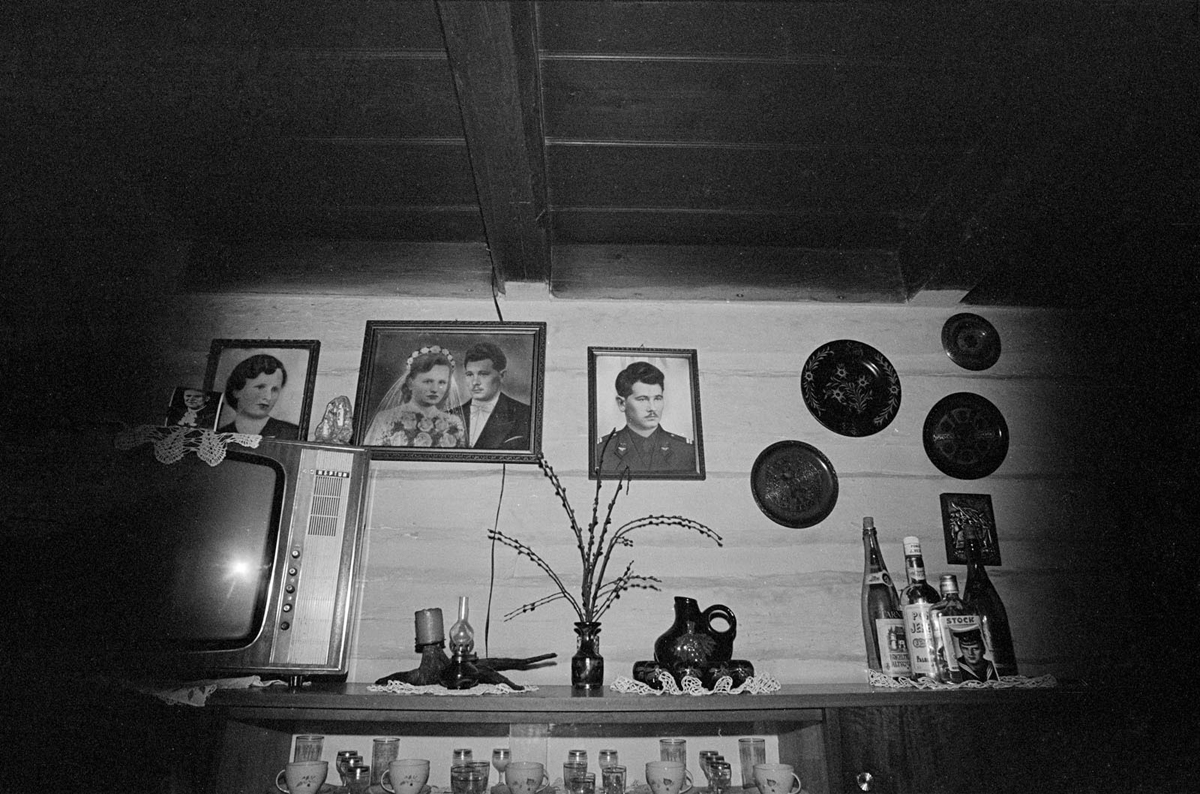
Monidła, Photograph from Zofia Rydet’s photo series Sociological Record, Chabówka, 1983 © Zofia Augustyńska-Martyniak. Image available under the CC BY-NC-ND 3.0 PL license. Source: zofiarydet.com
From Photograph to Portrait: The Process of Producing Monidła
The production of a portrait consisted of several stages and involved different individuals responsible for successive phases of the work. Efficient cooperation was essential, as each stage influenced the final result. A key role in acquiring customers was played by pedlars, who travelled through villages and towns, visiting private homes, apartments, and workers’ hostels. They offered portraits and encouraged the customers to place orders. “He would come and ask whether someone wanted to have a portrait made, you know? Back then it was fashionable, everyone was doing it. And I gave them my photograph,”[15] recalls one of my interviewees. When asked whether the pedlar was someone local or rather an outsider, she replied emphatically: “No, no, no, he was from outside.”[16]
In Communist Poland, door-to-door sales constituted a common form of goods distribution. Pedlars primarily offered everyday household items and decorative objects, such as domestic textiles, bedding, and tableware, as well as images, embroideries, wall hangings, and mass-produced prints. “Those kinds of pictures were everywhere; they went from house to house selling them. Before, wall hangings were very fashionable,”[17] another interviewee recalls.
Door-to-door sellers had to demonstrate considerable charisma and persuasive skills. Their effectiveness directly affected their earnings: the more clients they managed to acquire, the greater their financial benefits. “Such a portrait cost two hundred and forty złoty; twenty percent went to the producer and another twenty percent to the pedlar,”[18] one of the sellers emphasizes. A convincing pedlar could therefore earn a substantial income.
In addition to charisma, the agents’ appearance also played an important role and left a strong impression on my interviewees. In his literary portrayal, Jan Himilsbach describes the seller as follows: “A young man of about thirty entered the apartment, elegantly dressed, wearing a soft hat and carrying a new leather briefcase under his arm.”[19] The briefcase was one of the key attributes of pedlars, as it was used to carry portraits, which were shown to potential clients as examples.
In order to produce a monidło, it was necessary to provide a photograph from which the portrait could be made. This often proved problematic, as many people did not own suitable photographs. This was particularly the case in the 1950s, when access to photography, especially in rural areas, was very limited. As a result, pedlars frequently accepted low-quality photographs, although their employers often admonished them for doing so.
Archival material includes reminders emphasizing the need for more careful selection of photographic material, for example: “Check the sharpness of the photograph carefully. Do not accept damaged or broken photographs. Do not accept photographs bearing stamps on the face,”[20] to ensure that a portrait of satisfactory quality could be produced.
The most common type of photograph received by pedlars were identification photos. However, it also happened that people handed over group photographs, taken at various family gatherings, and even at funerals. In some cases, when such photographs were poorly described and subsequently passed from hand to hand within the workshop, confusion arose as to which person was to be depicted in the monidło. As a result, complaints sent to workshops include statements such as: “The complaint has been accepted. The incorrect depiction of the male figure resulted from an unclear description provided by the pedlar. After the correct photograph of the man was submitted, the portrait was produced again.”[21]
Monidła are sometimes interpreted as a sign of social aspiration and as a means of consciously shaping one’s visual self-representation. However, the scope of such freedom was often limited. Idealization did not imply unrestricted choice, and customers’ expectations were usually structured by ready-made solutions proposed by pedlars. The previously cited document concerning the work of pedlars reads: “Clients’ wishes should be specific and concise.”[22]
After the deposit was paid, the photo was taken to the studio, where it was enlarged. The Polish photographer Witold Englender describes this process: “The photographs were reproduced; copies were made with an effort to preserve proportions; they were mounted onto a backing and reproduced once again after the joints had been retouched. From this reproduction, a photographic print was produced, and then the monidło.”[23] In some cases, in order to strengthen the visual effect and give the representation a more ‘painterly’ character, the enlarged photograph was mounted on canvas.
The next stage involved the manual correction of the image. It was at this point that the photograph was subjected to interventions intended to give it the qualities of a painted portrait. “I had very little to do with photography, because it wasn’t photography. It was painting, painting portraits. That’s how it worked: they enlarged the photographs, and then you had to dress them, shape the face, […] renew it, so to speak,”[24] emphasizes Krystyna, a portraitist who worked in one of the studios. It was she, among others, who was responsible for producing monidła. She added jewellery, arranged hairstyles, and altered the clothing of the depicted figures.
Time constraints and, at times, insufficient skills sometimes led to the production of images with a caricature-like character. The problem was particularly evident in cases where two separate photographs were combined into a single portrait. One interviewee, who worked in a workshop producing monidła, recalls: “I had a job like that which I still can’t get over, for example … two children. Two children, a girl and a boy, standing next to a large flower. The boy was seven, maybe six, and tall, and the girl was four, maybe three years old … very small. And the woman who made the enlargements enlarged them to the same height, it was horrible, it was awful. The girl came out big and fat, and the boy … the boy was … I argued with them, I didn’t want to do it.”[25] Such situations resulted in customer dissatisfaction and, consequently, in complaints; these, in turn, could lead to deductions from wages or formal reprimands for the workshop’s employees.
Image Modifications and the Functions of Monidła
“Wedding, fashionable, semi-colour, light background, tie, flower.”[26] Such a note, written by a pedlar, appears beneath two photographs fastened together with a paper clip. Although buyers had the option of choosing a so-called “original” version, they more often opted to enrich the portraits with various attributes and other minor interventions in relation to the photograph. These practices included both the addition of desired elements, such as jewellery, elegant clothing, or carefully styled hairstyles, and the correction or elimination of features considered undesirable, for example, the removal of headscarves, the correction of a squint, or the masking of baldness. Such procedures resulted in images that were less realistic; rather, they reflected how the portrayed person wished to be seen or remembered.
Interventions did not always stem solely from a desire to “improve” one’s appearance. Modifications such as adding hair were sometimes interpreted as attempts to compensate for personal insecurities; yet in many cases monidła were commissioned a considerable time after the event they were meant to depict, such as a wedding. In this context, image alterations could serve less to correct a present appearance than to return to an earlier, youthful look and to fix an imagined image of oneself from years past.
The most common type of image consisted of the so-called “wedding montages”, that is, monidła created from two (usually identification) photographs of the spouses. The portrayed individuals had to be dressed and styled. “Lady: wavy hair, white dress with a small neckline, veil with a small crown, and a bouquet of roses.”[27] Whether the portrait was meant to evoke the memory of a specific moment and depict the couple in a manner close to reality, or to present an image adjusted to contemporary ideals of fashion and attractiveness, depended on the buyers’ preferences. Both approaches were common: monidła could serve as a means of returning to earlier years, but also as a means of compensating insecurities and fulfilling visual desires. Interestingly, in this type of representation, the man was usually placed on the right-hand side, while the woman appeared on the left, a composition that evokes associations with their positioning during a wedding ceremony.
“Were those fox furs fashionable at the time?”[28] I asked one of my interviewees. In the portrait, she wore decent makeup, with elegantly styled hair and a shawl draped around her shoulders. “It was a dream to have something like that,”[29] she replied. In her monidło, she wished to include an elegant white fox fur stole, an accessory she could not actually afford. Instead, she could afford a monidło, albeit with some difficulty. The portrait thus became, in a sense, a substitute for an unattainable luxury item.
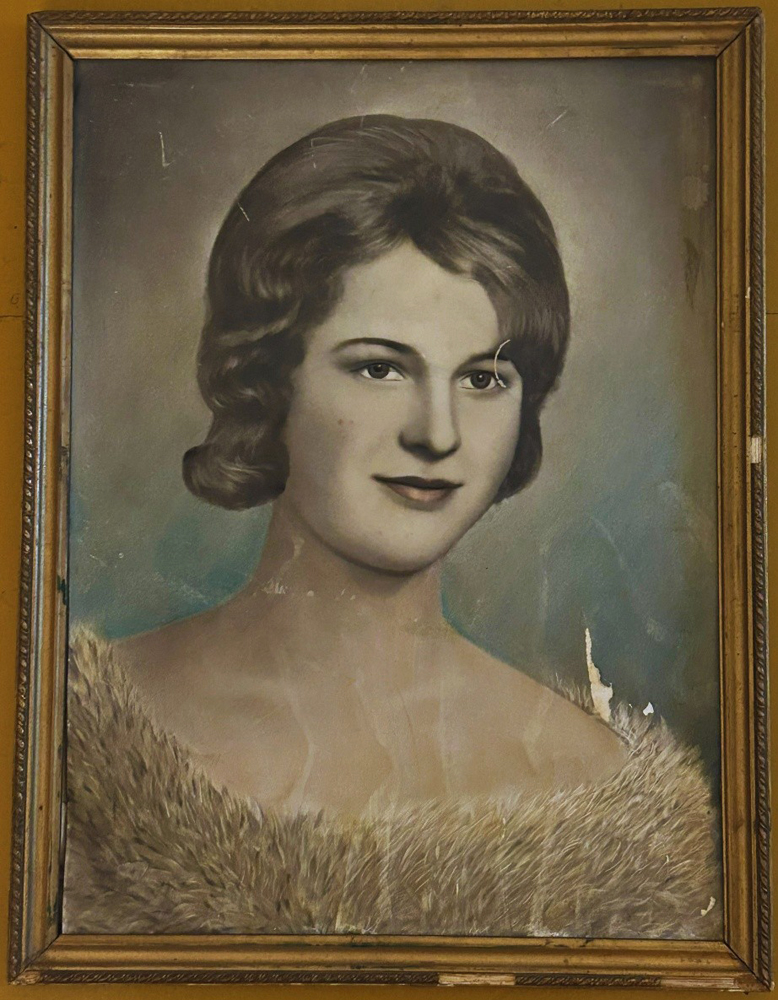
Monidło of the author’s interviewee, Halina, Dunowo, 2025. The portrait was made in the
second half of the 1960s. Author’s own collection
The decision to commission monidła was shaped by a variety of factors. As already indicated, a significant role was played by pedlars. However, customers’ motivations were equally important. They can be traced both in oral histories and in the few existing written sources. The most frequently mentioned reason for purchasing them was the desire to leave one’s image to own children, understood as a keepsake and a form of intergenerational visual transmission. An interviewee explained: “I wanted such a portrait. I thought maybe the children would take it.”[30] A similar view is expressed in a complaint in which the author states that he would not accept an unsatisfactory portrait, because “the children would have no keepsake at all, since they would not recognize the likeness.”[31]
Interventions applied to the photographs sometimes resulted in memories becoming anchored in the image preserved in the monidło, rather than in actual appearance or previously owned objects. Both the portrayed individuals and their children often remembered them not as they had been in reality, but in the form fixed in the image, together with attributes that frequently existed only in the portrait and reflected the way in which the person wished to be remembered.
“My parents did not have any wedding photograph. It did not bother them, but it greatly upset my grandmother. […] So she took a photograph of my parents that had been taken at my christening and brought it to a specialist, who painted in what was needed: a veil, a wedding dress, and a bouquet for my mother; a white bow tie and a suit for my father. And although they had worn entirely different outfits at their actual wedding, I can no longer imagine it any other way,”[32] as one of the women quoted in the press article “Monidło. Portret małżeński” (Monidło: A Marital Portrait) emphasizes.[33]
One of the most frequently cited motifs identified by researchers is the desire to possess something prestigious, to appear modern, or to own a “proper” portrait.[34] In case of individual portraits, clear differences emerged in the ways women and men were represented. Female monidła were dominated by elegant clothing, pearls and necklaces, and carefully styled hairstyles, emphasizing the festive and representative character. Typically for the visual genre of portraiture, men chose images with a memorial character, particularly those depicting them in military uniforms, referring to experiences of service and associated values.[35]
Monidła were also produced as memorials. One of the producers emphasizes: “Many people had already passed away, and they would ask for portraits to be made from photographs of those who were no longer alive.”[36] This function is further confirmed by photographs taken by Zofia Rydet, a famous Polish photographer who documented everyday life. Many of her photographs depict monidła showing deceased persons, sometimes adorned with black ribbons.[37] This practice clearly indicates the memorial character of monidła and confirms their role in private memory rituals.
After completion, monidła were most often sent to customers by post. The moment of receiving the portrait was undoubtedly a confrontation between earlier expectations and the final result, which, as in the case of Marcin Zając, sometimes proved to be a great disappointment. “After some time, I received a notice to collect the portrait […]. Upon collection, it turned out that the glass was broken, the frame had shifted to the side, and the portrait had been damaged by shards of glass, and most importantly, the figures painted in the portrait did not look as agreed: neither were they similar, neither one nor the other,”[38] writes the dissatisfied client. Other complaints usually concerned the improper positioning of figures, confusion regarding which individuals were to be depicted, or incorrect proportions, often in the case of children. The majority of complaints were accepted in order “to avoid further unpleasant complaints.”[39]
The Portrait in the Domestic Space
Once in the home, the portrait entered the sphere of domestic relations. Its fate depended on the reactions of the recipients: it could be placed in a wardrobe, displayed in a less frequently used room, or, as in the case discussed below, occupy a prominent place within the home.
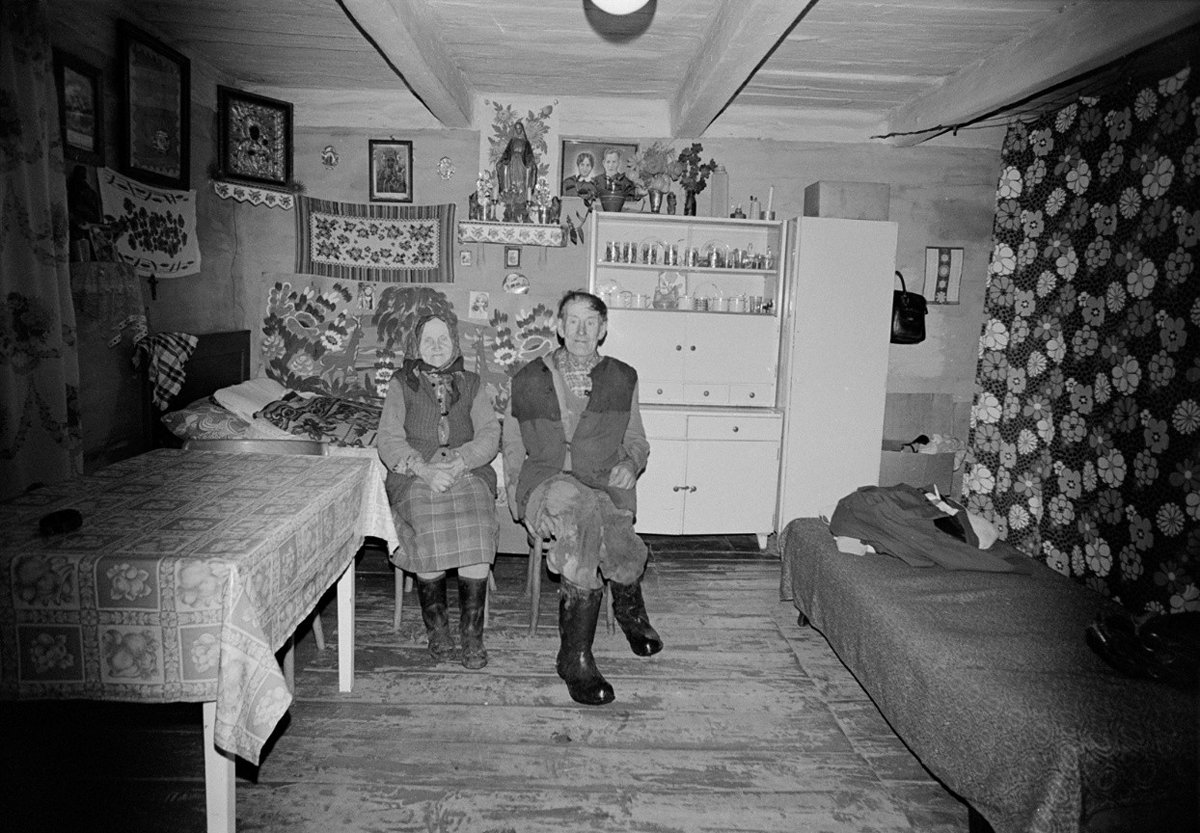
Photograph from Zofia Rydet’s photo series Sociological Record, Cmolas, 1980 © Zofia Augustyńska-Martyniak. Image available under the CC BY-NC-ND 3.0 PL license. Source: zofiarydet.com
In one of Zofia Rydet’s photographs, we see an elderly couple seated in a way that ensures that as many decorative elements of the interior as possible are included within the frame. They are surrounded by floral-patterned curtains, wall hangings, a sideboard filled with glassware, and numerous small objects that together create a dense, visually saturated space. Zofia Rydet’s photo series Sociological Record provides one of the few opportunities to gain insight into the interiors of rural houses and apartments, spaces usually inaccessible to external gazes and today largely no longer existing or already forgotten.
“These interiors were shaped under the influence of sacred models, which for their inhabitants represented an image of high culture. Sideboards and cabinets were often placed not along the walls, as was customary in urban apartments, but in corners and at a slight angle, resembling side altars in a church,”[40] writes historian Błażej Brzostek. This arrangement becomes particularly visible in Zofia Rydet’s photographs. We see various images that were often offered by pedlars, among them not only monidła but also representations of the Virgin Mary and Pope John Paul II. This arrangement symbolically elevated the family to a sacred status.
The placement of the image also fulfilled a magical or protective function. The photographer Agnieszka Pajączkowska explains the significance of hanging monidła in the bedroom: “Sometimes they were hung above the marital bed, and I heard that it functioned as a kind of talisman for a successful marriage, because it allowed one to recall the person one had once fallen in love with.”[41]
Among the places where monidła were also displayed was the space above the television set. Contrary to the religious arrangement, the television set provided an opposite context. Due to the limited availability of goods and services in Communist Poland, a figure of an elegantly dressed man could be perceived as a symbolic intermediary granting access to the urban world and to modernity. In the interviews, it was repeatedly mentioned that monidła were “fashionable”, “something worth having”, especially since, as interviewees emphasized, “everyone had one”.[42] At the same time, the placement next to the television set was highly visible. It presented the monidło to visiting guests and endowed it with a representative function.
Conclusion
Monidła constitute a significant, though long overlooked, element of twentieth-century Polish visual culture. From the late 1970s onwards, they gradually began to disappear from domestic interiors: they were taken down from walls, moved to less visible spaces, or removed altogether as tastes changed and new visual models gained prominence. Once associated with modernity and prestige, monidła came to be perceived as outdated or unfashionable. At the same time, in recent years, a renewed interest in these vernacular images has emerged, visible in academic research, museum collections, exhibitions, and local cultural initiatives.
For a researcher, monidła are distinctive because they demonstrate the process of constructing a desired image, not only through explicit visual modifications but also by creating representations that transcend the moment of exposure; they combine the living and the deceased and create new, imagined scenes. From the perspective of visual studies, monidła are particularly valuable as they function not merely as visual objects but as traces of everyday visual practices. They reveal social aspirations, modes of self-presentation, and visual agencies in everyday life; they demonstrate forms of appearance that were considered desirable and forms of visual participation in the construction of identity and memory. Moreover, situated within the broader history of portraiture, monidła respond to the enduring need for remembrance. As Peter Burke has observed, both painted and photographic portraits record not so much social reality as social imaginings.[43] Monidła offer a way to explore practices of self-presentation, particularly among social groups less frequently examined in portrait studies.
An analysis of their production, circulation, and usage within the domestic space demonstrates that monidła were more than mere outcomes of commercial transactions. They constituted a practice that combined semi-mass production with individual needs related to memory, aspiration, and self-representation. Standardized visual schemes did not preclude the attribution of personal meaning, which became evident both in the selection of image modifications and by the way portraits were displayed within one’s own home. Monidła thus operated at the intersection of private life and popular culture, revealing how images participated in everyday memory practices and shaped self-perceptions within the social realities of twentieth-century Poland.
[1] Interview with two residents of Laski Koszalińskie, Otolia and Władysław, February 2023, conducted by the author Alicja Kowalska.
[2] Ibid.
[3] Fieldwork conducted in 2023 as part of the author’s BA thesis, in the West Pomeranian Voivodeship, in the villages of Laski Koszalińskie and Dunowo; based on oral history interviews.
[4] For key studies, see: Agata Dymała, Monidło na tle przemian kultury ludowej, in: Prace Kulturoznawcze, Wrocław 2023; Paulina Kwiatkowska, Monidło, in: Iwona Kurz/Paulina Kwiatkowska/Magda Szcześniak/Łukasz Zaremba (eds.), Kultura wizualna w Polsce, vol. 2: Spojrzenia, Warszawa 2017; Katarzyna Szwiec, Koniec „ery retuszerstwa”?, in: Annales Universitatis Paedagogicae Cracoviensis, Kraków 2013.
[5] For exhibitions devoted to monidła, see: Żyli długo i szczęśliwie tutaj, Warszawa 2025; Monidło. Portret ślubny, Wrocław 2026; Monidło. Kolejna próba rehabilitacji; Kielce 2012, Opowieści spoza obrazów, Wrocław 2019; Magia monidła. Zbiory, kolekcje, definicje, refleksje, Łódź 2012.
[6] Andrzej Różycki, Magia monidła, exhibition catalogue, Galeria 87, Łódź 2011.
[7] “It should be borne in mind, however, that the semantic scope of this term is sometimes extended on an ad hoc basis and may also refer to other techniques of producing popular images, such as fairground photography, particularly posed portraits taken against simple painted backdrops or those based on placing the sitter’s head through an opening in a prepared cut-out board.” Kwiatkowska, Monidło, pp. 68-77.
[8] Although images of this type already appeared in the nineteenth century, this article focuses on the period of the People’s Republic of Poland (PRL). This limitation results from the nature of the collected research material: both the accounts of interviewees and the analyzed objects refer almost exclusively to the realities of PRL.
[9] Monidła can be described as semi-mass-produced: their creation relied on established schemes and a division of labor characteristic of serial production, while at the same time retaining elements of manual execution and the possibility of introducing individual modifications.
[10] Słownik języka polskiego, “mamić”, https://sjp.pwn.pl/sjp/mamic;2481034.html [07.05.2026].
[11] Ibid.
[12] Olga Drenda, Róże i szparagus, in: dwutygodnik.com, July 2021, https://www.dwutygodnik.com/artykul/9606-roze-inbspszparagus.html [07.05.2026].
[13] Jan Himilsbach, Monidło, Warszawa 1967.
[14] Beyond Himilsbach’s text, the term monidło began to appear in the press only in the mid-1970s. From the outset, however, it was burdened with pejorative connotations and, within metropolitan opinion-forming discourse, was often associated with kitsch.
[15] Interview with a female resident of Grajewo, Bożena, July 2025, conducted by the author Alicja Kowalska.
[16] Ibid.
[17] Interview with a female resident of Laski Koszalińskie, Helena, April 2025, conducted by the author Alicja Kowalska.
[18] Anna Poppek, Rejs na krzywy ryj … czyli Jan Himilsbach i jego czasy …, Kraków 2024, p. 54.
[19] Jan Himilsbach, Monidło, Warszawa 1970, p. 32.
[20] These materials consist primarily of administrative documentation concerning the functioning of one of the workshops producing monidła, such as client complaints, records of dispute resolutions, and guidelines for employees. State Archives Lublin, Wojewódzki Zarząd Spółdzielni Pracy w Lublinie, file no. 835, 1954-1956.
[21] Ibid.
[22] Ibid.
[23] Witold Englender, Małe conieco nie tylko o fotografii, Zielona Góra 2009, p. 103.
[24] Archival interview with a female portrait painter, conducted by Tomasz Czajkowski, February 2013, “Brama Grodzka – Teatr NN” Centre, Lublin.
[25] Ibid.
[26] Władysław Grochowski, Album Zdjęć Rodzinnych, competition project prepared for the Złoty Jantar competition, 1977, author’s archive.
[27] Ibid.
[28] Interview with a female resident of Dunowo, Halina, April 2025, conducted by the author Alicja Kowalska.
[29] Ibid.
[30] Interview with a female resident of Laski Koszalińskie, Helena, April 2025, conducted by the author Alicja Kowalska.
[31] Władysław Grochowski, Album Zdjęć Rodzinnych, competition project prepared for the Złoty Jantar competition, 1977, author’s archive.
[32] Beata Turska, Monidło: Portret Małżeński, in: Super Express, 18 November 2000, cited in: Ewa Martyniszyn, Opowieści spoza obrazów, Wrocław 2019, p. 7.
[33] Ibid.
[34] Agata Dymała, Monidło na tle przemian kultury ludowej, in: Prace Kulturoznawcze, Wrocław 2023; Katarzyna Szwiec, Koniec „ery retuszerstwa”?, in: Annales Universitatis Paedagogicae Cracoviensis, Kraków 2013.
[35] Accessories present in the portraits reinforced the self-presentation of the depicted individuals, and some of them, as in the example above, referred to specific social roles. These practices can be situated within a longer tradition of representing the figure, which became democratized in the era of studio portraiture. By masking social differences, studio photography, much like monidła later, allowed for a temporary “escape from reality” and the presentation of oneself in a more desirable way. Peter Burke, Eyewitnessing. The Uses of Images as Historical Evidence, London 2001, pp. 26-28.
[36] Archival interview with a female portrait painter, conducted by Tomasz Czajkowski, February 2013, “Brama Grodzka – Teatr NN” Centre, Lublin.
[37] Kwiatkowska, Monidło, p. 76.
[38] Władysław Grochowski, Album Zdjęć Rodzinnych, competition project prepared for the Złoty Jantar competition, 1977, author’s archive.
[39] State Archives Lublin, Wojewódzki Zarząd Spółdzielni Pracy w Lublinie, file no. 835, 1954-1956.
[40] Błażej Brzostek, Życie codzienne kobiet w PRL-u, Warszawa 2025, p. 359.
[41] Agnieszka Pajączkowska, Nieprzezroczyste. Historie chłopskiej fotografii, Wołowiec 2023, p. 223.
[42] Interview with a female resident of Laski Koszalińskie, Helena, April 2025, conducted by the author Alicja Kowalska.
[43] Burke, Eyewitnessing, p. 28.
Zitation
Alicja Kowalska, Monidła in 20th-Century Poland: Between Art, Commerce, and Social Aspiration, in: Visual History, 18.05.2026, https://visual-history.de/2026/05/18/kowalska-monidla-in-20th-century-poland/
DOI: https://doi.org/10.14765/zzf.dok-3052
Link zur PDF-Datei
This text is published under the CC BY-SA 4.0 license. It may be used for commercial purposes, in excerpts or in modified form, provided the author and source are credited. Images included in the article are not covered by this license. For detailed information about this license, please visit: https://creativecommons.org/licenses/by-sa/4.0/
