Photo Albums and the First World War in East and Southeast Europe
(1912-1923) Medium - Memory - Object | Conference: Justus-Liebig-University Giessen, November 19-20, 2026
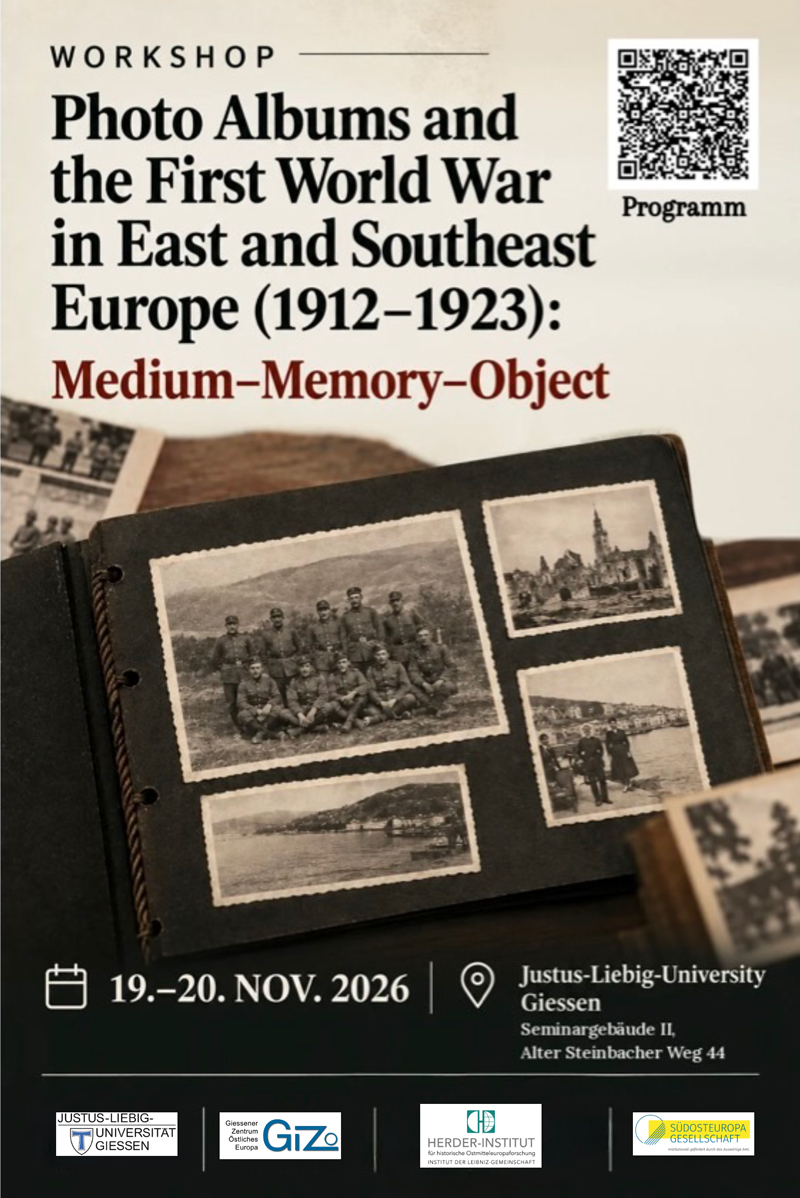
Numerous photo albums and collections from the two World Wars are held in German archives alone—often poorly inventoried or insufficiently processed. The number of albums forgotten in private hands on attics, in basements, or in boxes is almost impossible to estimate. We do not know how many albums were discarded due to ignorance, lack of interest, lack of space, or shame. At the same time, photography is still rarely taken seriously as an independent primary source in historical sciences. Most often, photographs serve as illustrations or as support for what already seems sufficiently proven through textual sources. However, research such as that by Anton Holzer on the First World War and Petra Bopp on the Second World War has long demonstrated the value of photography for both military and cultural/art history. For instance, photographs—and private albums in particular—help to reconstruct the daily lives of combatants and civilians, provide insights into local frontline developments, devastation, and environmental destruction, as well as gender relations. They also illuminate, for example, how people remembered wars and provide insight into why men and women became perpetrators.
At the same time, the First World War marked a decisive turning point in the history of photography and image production. In Western Europe, for many people, the memory of war is primarily shaped by the numerous images of the battlefields. On one hand, warring states began to systematically use official propaganda and documentation material for their war aims, while simultaneously introducing strict censorship mechanisms. On the other hand, portable and relatively inexpensive cameras for the first time enabled the production of a mass of private visual testimonies „from below,“ which were often found in private photo albums or collections. Particularly in combination with field letters, diaries, or official documents, such photo collections allow for a nuanced reconstruction of the course of the war. They help to fill knowledge gaps, confirm, supplement, or challenge established (master) narratives. They contribute to making „forgotten,“ marginalized, and research-neglected war theaters in Eastern and Southeastern Europe more visible. Accordingly, the conference treats the First World War through a broad temporal lens, including the Balkan Wars and the subsequent conflicts across the Eastern Mediterranean and Eastern Europe.
Conference Table
Thursday, Nov. 19th 2026
15 – 15:45 Uhr: Welcome and Introduction to the Conference (Prof. Dr. Nicole Immig)
15:45 – 16 Uhr: Coffee Break
16 – 17:20 Uhr: Panel 1 „Women in War Photography“ (Chair: Anna Busch)
Tamara Scheer (University of Innsbruck/ University of Vienna): The Roman Catholic Sisters of the Sacred Heart of Jesus and their Balkan Wars and the First World War Chronicle (1912-1919)
Alexander Bonk (Justus-Liebig-University of Gießen): „Living Sights“? – Women in private Soldier’s albums of World War I
17:20 – 17:40: Coffee Break
17:40 – 19 Uhr: Panel 2 „Photography from Southeastern Europe“ (Chair: Nicole Immig)
Danilo Šarenac (University of Belgrade): War as a Cultural Encounter? Serb-German Contact Recorded on War Photographs (1915-1918)
Maria Xypolopoulou (Association internationale des critiques d’dart France): Curating the Front: Selection, Omission and Everyday Memory in Private Photo Albums from Gallipoli and the Macedonian Front (1915-1918)
19:30 Uhr: Opening Conference Dinner in Gießen
Friday, Nov. 20th 2026
9 – 11 Uhr: Panel 3 „Photography from Eastern Europe“ (Chair: Michaela Scharf)
Richard Gion (Ludwig-Maximilian-Universität of Munich): Bilder der Gefangenschaft: Eine Text-Bild-Analyse habsburgischer Ego-Dokumente aus Sibirien (1914-1922)
Reinhard Nachtigal (University of Freiburg): Die private Fotosammlung eines Fotografen und Frontsoldaten Miloš Vojinović (Serbian Academy of Arts and Sciences): How Arius van Tienhoven’s Album Narrates the First World War in Serbia, 1914-1915
11 – 11:15 Uhr: Coffee Break
11:15 – 13:15 Uhr: Panel 4 „Collection and Potential Research“ (Chair: Christian Lotz)
Thomas S. Carhart (Technical University of Brandenburg): Projekt zur digitalen Erfassung von Privatfotografien Deutscher Militärangehöriger seit Beginn der Kleinkamerafotografie
Albert Caspari (Informationszentrum Baltische Staaten e.V.): Aus dem INFOBALT-Archiv: die Sammlung Erwin Biesenbach
Christian Westerhoff und Tobias Thelen (Württembergische Landesbibliothek): Die Sammlung Zeit der Weltkriege der Württembergischen Landesbibliothek: Ein bisher kaum bekannter Fotobestand zu Ost- und Südosteuropa
13:15 – 14:30 Uhr: Lunch
14:30 – 18 Uhr: Excursion to the Herder Institute Marburg and Discussion
Elke Bauer, Sebastian Weiß, Marie Werner und Christian Lotz (Herder-Institut Marburg): Bildliche, textliche und kartografische Quellen zum Ersten Weltkrieg in Ostmitteleuropa: Fragestellungen und quellenkritische Herausforderungen
18:30 Uhr: Closing Conference Dinner in Marburg
19-20 Nov. 2026, Justus-Liebig-Universität Gießen
Seminargebäude II/ Seminar-Building II, Alter Steinbacher Weg 44, 35394 Gießen, Room S 303

