About the Project
With the Visual History internet portal, the Leibniz Centre for Contemporary History Potsdam (ZZF) operates a communication and information platform that provides current insights into the growing community of historical image research and aims to sensitize a history-minded public to the specific nature of visual evidence as part of our cultural heritage.
Through various contribution formats, the weekly updated blog presents central concepts and research fields while taking a closer look at the actors within the image industry. The blog bundles information on conferences, exhibitions, and relevant new publications, and publishes a wide range of contributions to the field of research. A particular objective of the portal is the presentation of current research projects. Interdisciplinary cooperation with those disciplines that traditionally work with visual sources—art history, media studies, cultural studies—is explicitly encouraged.
The Visual History online portal was launched at the end of 2013 to accompany the collaborative project Visual History: Institutions and Media of Pictorial Memory. The joint research project of the Centre for Contemporary History Potsdam (PD Dr. Annette Vowinckel and Dr. Jürgen Danyel), the Herder Institute in Marburg (Prof. Dr. Peter Haslinger), the Georg Eckert Institute for International Textbook Research in Braunschweig (Prof. Dr. Simone Lässig), and the Deutsches Museum in Munich (Dr. Wilhelm Füßl) was funded from 2012 to 2016 as part of the Leibniz Association’s competitive funding process.
As part of the project, a book series was established with Wallstein Verlag:
Visual History: Images and Pictorial Practices in History, edited by Jürgen Danyel, Gerhard Paul, and Annette Vowinckel
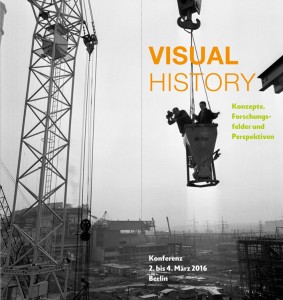
Conference poster “Visual History: Concepts, Research Fields and Perspectives” for the conclusion of the project, March 2016 in Berlin. A team from the Hungarian television station MTV at the construction site of a power plant near the Danube. Photographer: Tamás Urbán, Hungary 1971 © Fortepan / Tamás Urbán